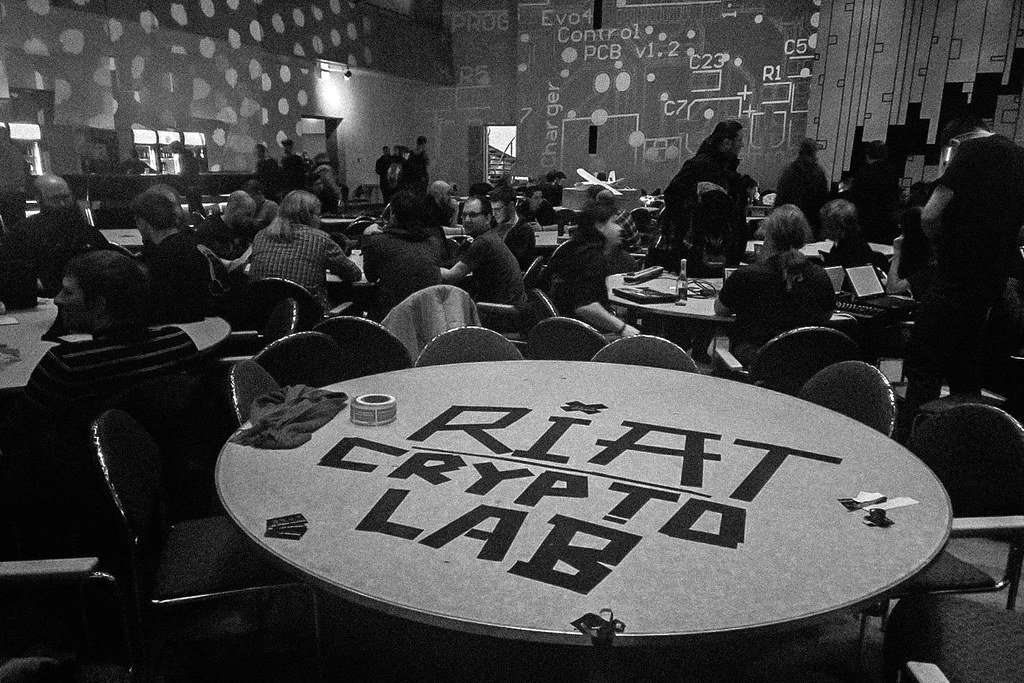
“RIAT Assembly at 33c3 Chaos Communication Congress, Hamburg” by riat.at is licensed under CC CC0 1.0
Crypto networks and Anonymous Trust Networks
As anonymous trust ideas developed, crypto networks appeared to offer a partial solution. They demonstrated, at scale, that you could coordinate strangers without central authority, that you could verify events without trusting institutions, and that cryptography could replace much of what used to require identity and reputation. In that sense, blockchains were a breakthrough. They showed that trust could be anchored in mathematics rather than people.
A deeper problem revealed
Crypto networks are excellent at technical trust – verifying transactions, enforcing rules, preventing double-spending, ensuring that the same event cannot be forged twice. What they are largely indifferent to is human trust. They don’t care why someone acts, whether an action is manipulative, whether incentives distort behaviour over time, or whether a system slowly trains its users to become more extractive, more adversarial, or more detached from real-world consequence.
In fact, most crypto systems explicitly avoid those questions. They treat human motivation as external, and assume that if incentives are aligned “correctly,” good behaviour will follow. History suggests otherwise.
Financialisaton first, ethics later
What emerged instead was a familiar pattern in a new technical form: financialisaton first, ethics later – if at all. Tokens became the primary signal of value. Speculation replaced participation. Influence accumulated to those who arrived early or had capital to deploy. Governance, where it existed, was often dominated by those same interests. The system remained cryptographically decentralised, but psychologically centralised around money, power, and attention.
This is not a criticism of cryptography itself. Cryptography is one of the essential tools that makes anonymous trust networks possible at all. The problem is what happens when encryption is mistaken for ethics, and when technical integrity is assumed to automatically produce social integrity.
Putting ethics first
Project AnonNet deliberately breaks with that assumption.
AnonNet borrows the technical insight – that trust can be verified without identity – but refuses the economic framing that usually comes with it. There are no tokens to accumulate, no markets to game, no attention loops to monetise. There is no growth imperative. There is no “number go up” metric waiting quietly in the background.
This is not an omission. It is a boundary.
Non commercial model
From the beginning, AnonNet accepts a difficult truth: That a network designed for psychological safety, expressive freedom, and genuine trust cannot be meaningfully commercialised without corrupting its own purpose.
The moment a network depends on scale for revenue, behaviour shifts. The moment engagement must be maximised, conflict becomes fuel. The moment data becomes an asset, users become resources. The moment influence can be bought, trust stops being earned.
We have seen this pattern repeat too many times to treat it as accidental. Social networks didn’t become extractive because they were poorly intentioned; they became extractive because their funding models quietly demanded it. Crypto networks didn’t become speculative because they forgot their ideals; they became speculative because financial incentives inevitably dominate systems that centre value transfer.
AnonNet chooses a narrower, harder path.
It assumes from the outset that it will be:
- smaller,
- slower,
- less visible,
- and less profitable,
than platforms optimised for growth or capital.
Design Constraint
That is not a failure mode. It is a design constraint.
Because AnonNet is not trying to capture people, keep them scrolling, or turn their interactions into data exhaust. It is trying to create spaces where people can engage without being shaped by invisible incentives. That means funding, governance, and infrastructure must remain deliberately modest, transparent, and bounded.
This is also why AnonNet’s trust model is experience-based rather than economic. Trust is not staked, traded, or transferred. It is not something you can lend, buy, or borrow. It emerges only through participation in shared structures – learning journeys, containment spaces, repair pathways – and it decays if those structures are abandoned.
In that sense, AnonNet sits in a space that neither social media nor crypto networks have been willing to occupy. It uses cryptography, but it does not worship it. It values decentralisation, but not at the expense of human coherence. It understands incentives, but refuses to let them quietly replace ethics.
Low cost, low impact
However, all that data, not being tracked and sent to anonymous individuals running tech firms, means that AnonNet can and will be extremely light weight. As will the apps. So much less code to write, so many less connections to maintain and report to.
A future where the user is the server
There is very much room, in the idea of a model where almost all user data lives with the user, and their own machine participates as a first-class node in the network. That network, not holding data, will have minimal impact on that users machine.
In fact, this is closer to the original spirit of the internet than what we have now.
Technically, we already know how to do this:
- personal machines can hold keys securely
- they can store encrypted data locally
- they can answer challenges and serve proofs
- they can come online intermittently without breaking continuity
What changed over the last 20 years wasn’t feasibility – it was economics and convenience. Central servers became the norm because they were easier to monetise, easier to scale fast, and easier to control. Not because they were inherently better.
AnonNet reverses data centrality
In the AnonNet model, the user’s machine doesn’t need to be a “server” in the old sense. It doesn’t need to be always-on, publicly addressable, or responsible for others’ data. It only needs to:
- hold the user’s private material
- generate and store proof tokens
- respond to challenges when the user is present
- optionally replicate encrypted fragments to peers
Sustainability: the question beneath the question
When people ask whether a system like this is sustainable, they often mean “can it grow indefinitely and make money?”
AnonNet answers a different question:
can it persist without corrupting itself?
On that axis, the user-as-server model is unusually strong.
Infrastructure sustainability
Because:
- users host their own data
- servers only handle lightweight coordination
- nothing needs to scale to billions of records
Hosting costs stay low and predictable. Growth increases participants, not central burden. That’s the opposite of today’s platforms.
Social sustainability
Because:
- participation has friction
- trust takes time
- bad actors gain no leverage
- identity resets are costly
…the network is designed to resist the classic collapse patterns of brigading, spam floods, reputation gaming, and performative outrage by making them far harder than traditional social networking platforms do.
For example, in AnonNet, network users can certainly open a shop. But, you cannot pay for advertising – it has to be word of mouth, based on a friends confidence in you, and personal recommendation. User will not see adverts, but those that choose to follow you will.
This isn’t accidental. It’s what happens when effort is moved back to the individual, instead of being externalised onto infrastructure.
Ethical sustainability
This may be the most important part.
A system where users hold their own data cannot easily be:
- bought,
- quietly repurposed,
- politically controlled,
- or turned into something else without their consent.
It forces honesty at the organisational level. If the network ever needed to change direction in ways that violated its principles, users wouldn’t need to protest – they could simply leave, without losing themselves in the process.
That’s a very different power dynamic.
The trade-offs (and why they’re acceptable)
This model does have costs:
- onboarding is slower
- recovery from lost keys must be designed carefully
- users must accept some responsibility
- the system will never be frictionless
But those are developmental costs, not extraction costs.
They teach:
- care
- continuity
- ownership
- reflection
Which, in AnonNet, are not bugs – they are outcomes.
What sustainability really means here
AnonNet is not sustainable in the way ad-driven or token-driven systems are sustainable.
It is sustainable in a quieter way:
- it can run for a long time without growing aggressively
- it can survive without becoming something else
- it can remain coherent under pressure
A network where users are the custodians of their own meaning, and machines merely coordinate trust, doesn’t need to conquer the world to be successful.
It just needs to remain intact.
That future is not only plausible.
Given everything we now understand about trust, power, and data – it may be the only one that scales without breaking.


0 Comments