Anonymous trust networks
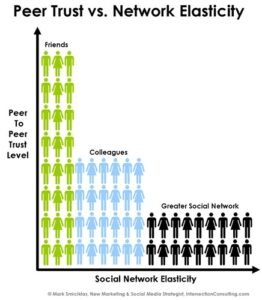
“Peer Trust + Network Elasticity” by Intersection Digital is licensed under CC BY-NC 2.0
Anonymous trust networks are an attempt to fix a contradiction the internet never resolved. We built networks where anyone can connect to anyone, but we quietly made that connection depend on identity, data capture, and central authority.
In practice that means you’re either known, and tracked, profiled, logged, judged by a platform, or you’re anonymous and untracked, but also treated as unaccountable, disposable, and therefore often distrusted.
We ended up with a false choice: privacy without trust, or trust bought by surveillance.
Anonymous networks
An anonymous trust network is a third thing. It’s a network where a person can stay unknown in the conventional sense- have no real name, no central profile, no platform-owned identity, while still being able to demonstrate that they are consistent, credible, and safe enough to interact with.
The trick is, that the network stops trying to “know” the person, and instead learns how to “verify” the person. In other words: the network’s job is not to store who you are; it’s to confirm that whatever you claim to have done, say, completed a learning journey, followed a process, earned a level of understanding, that was genuinely done, without needing to collect your private life to prove it.
The history of network anonymity
Historically, anonymity on networks began with the simplest goal: hide location and identity from observers. Onion routing and systems like Tor were designed to make it difficult for anyone watching the network to link the sender and the recipient, by routing traffic through multiple relays so no single point sees the whole picture. (Wikipedia)
That solved a vital problem, that of privacy under surveillance, but it left the other problem untouched: once you remove identity, how do you prevent the network from being destroyed by abuse? Tor, for example, is intentionally not a reputation system; it prioritises privacy and censorship resistance, and as critics often point out, that leaves abuse-handling as a hard, mostly externalised problem. (The Guardian)
This is the exact trade-off most “pure anonymity” systems run into: if you can’t link actions over time, you can’t form stable trust, and if you can’t form stable trust, you end up relying on heavy moderation or accepting chaos.
What does trust mean?
The next wave of ideas tried to redefine what “trust” even means online. Instead of trusting people, you trust the protocol: cryptography, consensus rules, and verifiable computation. This is where the language of “trustless systems” comes from. There are systems that don’t require you to trust a central intermediary, because participants can verify outcomes independently. (BCB)
In the crypto world that usually refers to transaction validity, but philosophically it’s a bigger move: it says “trust should be a property of the rules, not a privilege granted by authority.”
Proof without identity
In parallel, identity researchers pushed another crucial shift: you don’t need to reveal identity to prove something about yourself. That’s the foundation of anonymous credentials and selective disclosure – systems where you can prove you have a property (age over 18, membership in a group, completion of a training) without revealing the underlying personal attributes. (ScienceDirect)
Modern standards like W3C Verifiable Credentials formalise the idea of cryptographically verifiable claims exchanged between issuers, holders, and verifiers. (W3C) And the cutting edge goes further: zero-knowledge credential systems can let someone satisfy complex access criteria without needing trusted issuers in the traditional sense, and without exposing the credential contents. (obj.umiacs.umd.edu)
Rejection of identity based proof
So the philosophy has been evolving in a clear direction: away from networks that collect identity to create trust, and toward networks that verify proofs to create trust. This is the pivot point that makes an “anonymous trust network” possible as a sane social space rather than a hiding place.
Project AnonNet
Project AnonNet sits in that newer interpretation. It’s not “everyone is invisible so anything goes.” It’s also not “everyone is watched so behaviour is enforced.” It’s the third option: a network that can confirm continuity, comprehension, and protocol-aligned behaviour without owning people’s data.
In our internal project language, we’ve been calling these confirmations “holes” and “fills”: the network stores only the outline of what a credible journey would look like, while the user holds the detailed experience and can later prove – cryptographically, and in sequence, that they genuinely were the individual who did those things.
That means the network can recognise a returning participant and measure shape of experience (depth in one “room” – information, training, or interactive experiences), as well as the breadth of experience in many environments, without needing to know what those environments were. These key items, when seen over time, allow for a high level of implied trust to be achieved, without knowing exactly why, or needing to build a dossier on them.
That’s the philosophical evolution in one line: anonymity used to mean “don’t let anyone know it’s me.” Anonymous trust networking means “don’t let anyone know it’s me, and still let the network know I’m real, consistent, and safe to connect with.”


0 Comments